|
|
|
Must-See Châteaux |
|
|
|
|
|
|
|
|
Jean-Claude Lapalu is one of the most admired, respected and influential winemakers on the entire contemporary Beaujolais scene. Based in Saint-Étienne-la-Varenne, at the foot of Mont Brouilly, in the southernmost cru of the Beaujolais region, he is "a darling of the Parisian wine scene" and "a leader of the natural wine movement in France" according to William Kelley of the Wine Advocate. His father and both grandfathers were winemakers before him, but sold their grapes to the local cooperative cellar. It was in 1995, at the age of 33, that Jean-Claude made the bold decision to vinify his own wines, guided by the teachings of Jules Chauvet, like the late Marcel Lapierre. On a 12-hectare estate of Gamay, farmed organically and biodynamically, with vines averaging 50 to 100 years of age, Jean-Claude has built since 1996 a range of natural cuvées, without chaptalization, without sulfur (except for a tiny dose at bottling for certain cuvées), aged in oak barrels from the Tronay forest, bottled at the time of the descending moon. All resulting in wines that are "lively, supple, sinuous and absolutely delicious" (Wine Advocate), rivaling the greatest cuvées of the region.
The Lapalu family has been established in Saint-Étienne-la-Varenne for several generations. His father and two grandfathers were winemakers, but in the dominant model of the time: the grapes went to the local cooperative cellar. Jean-Claude inherited these vines and this tradition, but nurtured a curiosity and ambition that led him to question this model. In 1995, at the age of 33, he made the decision to change everything: he stopped delivering his grapes to the cooperative and began vinifying himself. In his first year, he vinified in a traditional manner. Then encounters and reading led him to Jules Chauvet, a biochemist and Beaujolais winemaker, a founding figure of natural wine, who had theorized and practiced sulfur-free, additive-free winemaking as early as the 1980s.
Following his teachings, as Marcel Lapierre had done at the same time, Jean-Claude quickly undertook the organic conversion of his vineyard. His wines soon attracted the attention of the most discerning enthusiasts, Parisian wine merchants, and foreign importers. International recognition came with the visit of Robert Parker, who did not wait for samples to be sent (Jean-Claude does not submit samples to critics, but does not refuse their visits), and who awarded exceptional scores to the 2003 vintage: 94/100 for the Brouilly Vieilles Vignes and the Cuvée des Fous. Since then, the estate has been eagerly sought abroad and customers are allocated. All production is sold without ever soliciting the press. "No overblown ego from the Lapalu family. Simply a passion for work done well."
The vineyard of Jean-Claude Lapalu extends over 12 hectares, spread around Saint-Étienne-la-Varenne and the Mont Brouilly, in the Brouilly cru in southern Beaujolais. The plots cover three appellations: Beaujolais-Villages, Brouilly, and Côte de Brouilly. The soils reflect the varied geology of the area: granitic sand (typical of Beaujolais), basalt on the Mont Brouilly for the Côte de Brouilly, and deep clay in certain lower-lying sectors. Since the 2010 vintage, the entire vineyard has been farmed under certified organic and biodynamic agriculture, with vines averaging 50 to 100 years of age depending on the plot. The Cuvée des Fous is the most illustrative of this obsession with old vines: it comes from vines planted in 1900, the oldest on the estate.
Jean-Claude approaches his cuvées according to a simple and illuminating philosophy: "wines to drink standing up, and wines to drink sitting down." The entry-level cuvées (Tentation, Beaujolais Nouveau, Eau Forte, Rang du Merle) fall into the first category: light, fruity, immediate. The single-vineyard cuvées (Croix des Rameaux, Cuvée des Fous, Alma Mater) fall into the second: deep, complex, age-worthy. This binary yet illuminating vision guides every vinification and every aging decision.
Jean-Claude Lapalu vinifies according to the principles learned from Jules Chauvet: strict carbonic maceration for most cuvées, no chaptalization, no added sulfur (except a tiny dose at bottling for certain cuvées), indigenous yeasts. Aging takes place in oak barrels from the Tronay forest, for varying lengths of time depending on the cuvée. Bottling is done during the descending moon, in the biodynamic tradition. Corks are natural cork. The Alma Mater cuvée is vinified in terracotta amphorae, developing a particularly silky texture and minerality. The Croix des Rameaux and Cuvée des Fous cuvées are aged in Burgundian barrels for 10 to 12 months.
Beaujolais Tentation: A red cuvée of generic Beaujolais appellation, the lightest and most accessible of the estate. "A wine to drink standing up," fruity and crunchy, with aromas of fresh small red fruits, a supple and refreshing palate. The estate's ultimate thirst-quenching wine, to be drunk cool within the year.
Beaujolais-Villages Nouveau: A Beaujolais Nouveau cuvée from Beaujolais-Villages, which "sets the standard" according to specialists. In contrast to industrial primeurs, this Beaujolais Nouveau by Jean-Claude Lapalu expresses a striking freshness and natural fruit, with a complexity and minerality unmatched for a primeur wine. His first Beaujolais Nouveau in 1996 immediately earned him a national reputation.
Beaujolais-Villages Rouge Le Rang du Merle: A red Beaujolais-Villages cuvée from a specific plot, in a fruity and mineral style. A joyful and expressive red wine, with aromas of red fruits and light spices, a fresh and lively palate.
Beaujolais-Villages Rouge Vieilles Vignes: A red Beaujolais-Villages cuvée from old vines aged 50 to 80 years. Together with the Brouilly VV, it represents approximately 60% of the estate's production. A red wine of greater concentration and minerality than the Rang du Merle, with aromas of black fruits, spices, and a characteristic granitic tension. A Beaujolais-Villages of beautiful depth.
Beaujolais-Villages Blanc CeBlanc: The estate's only white cuvée, from Chardonnay. "Summer in my glass" according to one taster: aromas of white fruits (pear, peach), a fresh and fruity palate, a light and refreshing finish. An original and precise Beaujolais white, to discover with light dishes or as an aperitif.
Côte de Brouilly: A red cuvée from the Mont Brouilly plots on basaltic soil, a unique terroir that distinguishes Côte de Brouilly from the Brouilly plain. A red wine of alpine minerality and freshness, with a structure and tension linked to the volcanic basalt.
Brouilly Vieilles Vignes: The estate's flagship red cuvée, alongside the Cuvée des Fous, from the old vines of Brouilly (50 to 80 years old on average). Together with the Beaujolais-Villages VV, it represents approximately 60% of total production. A red wine of beautiful depth and remarkable granitic minerality, with aromas of black cherry, blackberry, and spices. Rated 94/100 by Robert Parker for the 2003 vintage.
Brouilly Croix des Rameaux: A prestigious single-vineyard red cuvée from a selection of the finest Brouilly plots. "The famous Croix des Rameaux cuvée" according to specialists. Aged in Burgundian barrels for 10 to 12 months. A red wine of great concentration and complexity superior to the estate's other Brouilly wines, with aromas of deep black fruits, spices, and beautiful depth. A Brouilly with great aging potential.
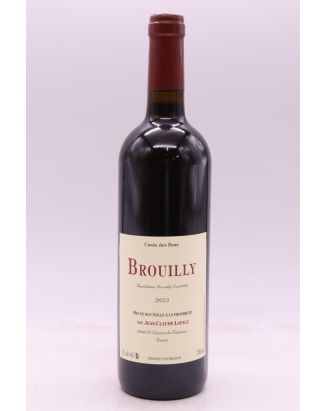
Brouilly Cuvée des Fous: A great iconic cuvée of the estate, from the oldest vines on the property, planted in 1900, on Brouilly. "Deep, dark, dominated by black cherry, one of Brouilly's aromatic signatures." Aged in Burgundian barrels. Produced in very limited quantities from the micro-yields of the century-old old vines. Rated 94/100 by Robert Parker for the 2003 vintage. A collectible wine with great aging potential.
Vin de France Eau Forte: A cuvée blending Beaujolais-Villages and Brouilly by carbonic maceration, "the lightest and most svelte expression of the range, with impressive persistence and length." A wine to drink standing up, the archetype of the elegant natural thirst-quencher, whose lightness conceals a true aromatic complexity.
Vin de France Alma Mater: A confidential cuvée vinified in terracotta amphorae, with "a particularly silky texture and minerality." The estate's most experimental expression, born of Jean-Claude's constant curiosity for alternative winemaking. A red wine of great finesse and unique expression, reflecting the soul of Gamay on the Brouilly terroir.
Vin de France Pinot Noir: A confidential cuvée from Pinot Noir, an atypical grape variety in Beaujolais. A red wine in a light and elegant style, with aromas of cherry and flowers, a fine and precise palate. A curious exploration by Jean-Claude outside the beaten paths of Gamay.
COLLECTION NEAR PARIS & VAT REFUND FOR TOURISTS
Free collection in our warehouse near central Paris (92)