
 Personalise your experience



 Sign in
 Cart
0
Cart
0


Premiers Crus Classés du Médoc: The excellence of the 1855 classification

The Premiers Crus Classés du Médoc: the excellence of the 1855 classification
The mention of the Premiers Crus Classés du Médoc stirs a particular emotion among lovers of fine wines. This exceptional group, born of the famous 1855 classification, embodies the elite among the châteaux of the Médoc. It captivates all those who wish to collect, taste, or gift the finest bottles of Bordeaux. Let us explore together this unique heritage to understand what sets these classified growths apart and why their reputation remains intact nearly two centuries after the original classification.
Key takeaways:
- 5 Premiers Crus Classés since 1855, virtually unchanged for 170 years: Lafite Rothschild, Latour, Margaux, Mouton Rothschild, Haut-Brion
- The only modification in 170 years: Mouton Rothschild promoted from 2nd to 1st in 1973, after decades of campaigning by Baron Philippe de Rothschild
- Haut-Brion is the sole exception outside the Médoc, produced in Pessac-Léognan (Graves)
- Full structure: 61 red classified growths ranked in 5 tiers (5 + 14 + 14 + 10 + 18) + 27 sweet white wines from Sauternes/Barsac
- Each château has its second wine: Carruades de Lafite, Les Forts de Latour, Pavillon Rouge, Petit Mouton, Le Clarence de Haut-Brion
- Legendary vintages: 1982, 2000, 2005, 2009, 2010, 2015, 2016, and the Parker 100/100 scores to note by château
- Indicative prices: from €500 (Haut-Brion) to over €3,000 (Lafite in great vintages), a heritage investment recognized worldwide
The 1855 classification: a benchmark still relevant today
The Universal Exhibition of Paris in 1855 marked a decisive turning point for the Bordeaux wine region. On that occasion, Napoleon III requested the creation of a classification ranking the finest red wines of the Médoc, based on their quality and price at the time. The local brokers, true connoisseurs, drew up a list intended to guide discerning enthusiasts and informed investors.
Since then, the 1855 classification has remained an indispensable benchmark in the world of classified growths. Even if some call for revisions, few other systems enjoy such international recognition. Owning a bottle from this selection is still today a guarantee of renown, reliable provenance, and often a remarkable aging potential.
The 5 Premiers Crus Classés du Médoc: complete profiles
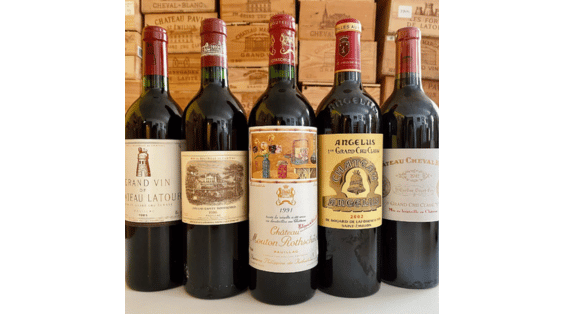
Château Lafite Rothschild (Pauillac): "The young lady of Pauillac"
The 112-hectare vineyard is divided into three plots: the slopes surrounding the château, the Carruades plateau to the west, and a 4.5-hectare plot in the neighboring commune of Saint-Estèphe. The terroir consists mainly of fine, deep gravel mixed with aeolian sand on a limestone bedrock. The grape varieties are 70% Cabernet Sauvignon, 25% Merlot, 3% Cabernet Franc, and 2% Petit Verdot.
In their style, the wines of Lafite Rothschild are often described as having a perfumed elegance and finesse, contrasting with the more powerful and masculine structure of Latour or the more exotic and intense flavors of Mouton.
|
Château Lafite Rothschild |
|
|
Appellation |
Pauillac |
|
Surface area |
112 ha |
|
Grape varieties |
CS 70%, Merlot 25%, CF 3%, PV 2% |
|
Aging |
18–20 months in 100% new oak barrels |
|
Second wine |
Carruades de Lafite |
|
Owner |
Famille Rothschild (Saskia de Rothschild) |
|
Aging potential |
30–50 years depending on vintage |
|
Indicative price |
600€ – 3 000 €+ |
Legendary vintages: 1921, 1945 and 1982, to which 2000 and 2005 can be added in more recent years. Lafite Rothschild received a score of 100/100 from Robert Parker for the vintages 1959, 2003, and 2010.
Château Latour (Pauillac): The colossus of Pauillac
Château Latour is a Premier Grand Cru Classé of Pauillac. The estate covers 65 hectares, including the 47 of the enclos surrounding the château, which produces the grapes for the fine wine. The estate is planted with 90% Cabernet Sauvignon and 10% Merlot.
Latour is the most structured and most concentrated first growth of the Médoc. Its "enclos", a central 47-hectare plot on a ridge of deep gravel, produces one of the most powerful and longest-lived wines of Bordeaux.
|
Château Latour |
|
|
Appellation |
Pauillac |
|
Surface area |
65 ha (47 ha "enclos") |
|
Grape varieties |
CS 90%, Merlot 10% |
|
Second wine |
Les Forts de Latour |
|
Third wine |
Pauillac de Latour |
|
Owner |
François Pinault (Artémis group) |
|
Aging potential |
30–60 years depending on vintage |
|
Indicative price |
500 € – 2 500 €+ |
Legendary vintages: 1961, 1982, 2000, 2003, 2009, 2010, 2015.
Château Margaux (Margaux): The aristocrat of the Médoc
Château Margaux has reigned over its eponymous appellation for centuries. Its style is the most elegant and floral of the five Premiers Crus, dominated by Cabernet Sauvignon yet with a delicacy that often draws comparisons to a great red Burgundy.
The estate extends over 262 hectares (including 87 ha of vines for the fine wine), on a terroir of deep Günzian gravel typical of the Margaux appellation. The château itself, a listed historic monument, is one of the most beautiful in Bordeaux.
|
Château Margaux |
|
|
Appellation |
Margaux |
|
Surface area |
87 ha of vines (fine wine) |
|
Grape varieties |
CS 75%, Merlot 20%, CF + PV 5% |
|
Second red wine |
Pavillon Rouge du Château Margaux |
|
Second white wine |
Pavillon Blanc (100% Sauvignon) |
|
Owner |
Famille Mentzelopoulos |
|
Aging potential |
25–50 years depending on vintage |
|
Indicative price |
500 € – 2 000 €+ |
Legendary vintages: 1900, 1961, 1982, 1986, 1990, 2000, 2009, 2015. Robert Parker awarded 100/100 to Château Margaux 1900 and 2015.
Château Mouton Rothschild (Pauillac): The rebel turned icon
Mouton Rothschild is the only château to have changed rank since 1855: classified Second in 1855, promoted to First in 1973 after a historic battle led by Baron Philippe de Rothschild. It is also the only Premier Cru to commission a great artist each year to illustrate its label: Picasso, Dalí, Warhol, Chagall, Bacon. A label collection that has become a worldwide artistic heritage.
|
Château Mouton Rothschild |
|
|
Appellation |
Pauillac |
|
Surface area |
84 ha |
|
Grape varieties |
CS 80%, CF 10%, Merlot 8%, PV 2% |
|
Second wine |
Le Petit Mouton |
|
Owner |
Famille Philippe Sereys de Rothschild |
|
Aging potential |
25–40 years depending on vintage |
|
Indicative price |
500 € – 1 500 €+ |
Legendary vintages: 1945 (Victory V label), 1982, 1986, 2000, 2009. Parker 100/100 for the 1945 vintage.
Château Haut-Brion (Pessac-Léognan): The exception of the Graves
Haut-Brion is the only Premier Cru located outside the Médoc. The only growth situated in the Graves, now the Pessac-Léognan appellation, Haut-Brion is the exception of the 1855 classification, a ranking centered on the Médoc where its reputation was too brilliant to be ignored.
Its terroir of Günzian gravel ridges, located a few kilometers from the center of Bordeaux (commune of Pessac), gives it a unique style: spicier, more mineral than the Pauillacs, with an earthy complexity all its own.
|
Château Haut-Brion |
|
|
Appellation |
Pessac-Léognan |
|
Surface area |
51 ha |
|
Grape varieties |
CS 45%, CF 37%, Merlot 18% |
|
Second red wine |
Le Clarence de Haut-Brion |
|
Second white wine |
Haut-Brion Blanc (Semillon + SB) |
|
Owner |
Famille Prince Robert de Luxembourg (Clarence Dillon Wines) |
|
Aging potential |
25–40 years depending on vintage |
|
Indicative price |
500 € – 2 000 €+ |
Legendary vintages: 1945, 1959, 1989, 1998, 2009, 2010, 2015. Parker 100/100 for 1989.
Comparative table of the 5 Premiers Crus Classés
|
Château |
Appellation |
Style |
Second wine |
Aging potential |
|
Lafite Rothschild |
Pauillac |
Finesse, floral elegance |
Carruades de Lafite |
30–50 years |
|
Latour |
Pauillac |
Power, minerality, structure |
Les Forts de Latour |
35–60 years |
|
Margaux |
Margaux |
Delicacy, floral, suppleness |
Pavillon Rouge |
25–50 years |
|
Mouton Rothschild |
Pauillac |
Richness, exoticism, spices |
Le Petit Mouton |
25–40 years |
|
Haut-Brion |
Pessac-Léognan |
Minerality, spices, complexity |
Le Clarence |
25–40 years |
The complete list of the 61 red grands crus classés 1855
Premiers Crus (5 châteaux)
- Château Lafite-Rothschild: Pauillac
- Château Latour: Pauillac
- Château Margaux: Margaux
- Château Mouton Rothschild: Pauillac (promoted 1973)
- Château Haut-Brion: Pessac-Léognan
Seconds Crus (14 châteaux)
- Rauzan-Ségla, Rauzan-Gassies (Margaux)
- Léoville Las Cases, Léoville Poyferré, Léoville Barton, Gruaud Larose, Ducru-Beaucaillou (Saint-Julien)
- Durfort-Vivens, Lascombes, Brane-Cantenac (Margaux)
- Pichon Baron, Pichon Comtesse de Lalande (Pauillac)
- Cos d'Estournel, Montrose (Saint-Estèphe)
Troisièmes Crus (14 châteaux)
- Kirwan, d'Issan, Giscours, Malescot Saint-Exupéry, Boyd-Cantenac, Cantenac Brown, Palmer, Desmirail, Ferrière, Marquis d'Alesme Becker (Margaux)
- Lagrange, Langoa Barton (Saint-Julien)
- La Lagune (Haut-Médoc)
- Calon-Ségur (Saint-Estèphe)
Quatrièmes Crus (10 châteaux)
- Saint-Pierre, Talbot, Branaire-Ducru, Beychevelle, Prieuré-Lichine (Saint-Julien)
- Pouget, Marquis de Terme (Margaux)
- Duhart-Milon (Pauillac)
- La Tour Carnet (Haut-Médoc)
- Lafon-Rochet (Saint-Estèphe)
Cinquièmes Crus (18 châteaux)
- Pontet-Canet, Batailley, Haut-Batailley, Grand-Puy-Lacoste, Grand-Puy Ducasse, Lynch-Bages, Lynch-Moussas, d'Armailhac, Haut-Bages Libéral, Pédesclaux, Clerc-Milon, Croizet-Bages (Pauillac)
- Dauzac, Du Tertre (Margaux)
- Belgrave, de Camensac (Haut-Médoc)
- Cos Labory (Saint-Estèphe)
- Cantemerle (Haut-Médoc)
The best vintages of the Médoc for the Premiers Crus Classés
|
Vintage |
Quality |
Dominant style |
Aging potential |
|
2022 |
★★★★☆ Very great |
Balance, purity, fine tannins |
20–30 years |
|
2020 |
★★★★★ Exceptional |
Tension, freshness, precision |
20–30 years |
|
2019 |
★★★★★ Exceptional |
Elegance, minerality, great classic |
25–35 years |
|
2018 |
★★★★☆ Very great |
Generosity, power, richness |
20–30 years |
|
2016 |
★★★★★ Legendary |
Structure, acidity, extreme aging potential |
30–40 years |
|
2015 |
★★★★★ Legendary |
Charm, opulence, accessible |
20–30 years |
|
2010 |
★★★★★ Legendary |
Concentration, perfect tannins |
30–50 years |
|
2009 |
★★★★★ Legendary |
Richness, ripe fruit, harmony |
25–40 years |
|
2005 |
★★★★★ Legendary |
Classicism, balance, great aging potential |
30–50 years |
|
2000 |
★★★★★ Legendary |
Millennial, perfect maturity |
30–50 years |
|
1996 |
★★★★★ Legendary |
Masterful Cabernet, absolute aging potential |
40+ years |
|
1982 |
★★★★★ Legendary |
The Parker revolution, a worldwide revelation |
40+ years |
Why has the 1855 classification not been revised?
This classification is widely criticized because it has never been revised (except in 1973 to promote Mouton Rothschild from 2nd to 1st), while some estates have been divided or sold many times over.
Supporters of the status quo argue that this immutability is precisely what gives the classification its value: investors, collectors, and global markets can rely on it over entire decades. Critics point to châteaux that would deserve promotion (Lynch-Bages, Pichon Comtesse, Pontet-Canet) and others whose quality may have evolved unfavorably.
The truth is that resistance to change comes partly from the châteaux themselves: being downgraded represents a considerable financial and prestige loss, and no consensus can be reached. It is precisely to avoid this pitfall that Saint-Émilion chose a classification revised every ten years, with the legal disputes that this generates.
Frequently asked questions about the Premiers Crus Classés du Médoc
What distinguishes a Premier Cru classé from another classified growth of the Médoc?
The Premiers Crus classés represent the qualitative pinnacle of the 1855 classification. Their name embodies tradition, viticultural excellence, and a rare aging potential. The difference lies in consistency, finesse of tannins, longevity, and renown. Certain other classified growths may rival them in great vintages, but the premiers remain the historical benchmarks.
- Consistency over several decades
- Remarkable longevity
- Unrivaled worldwide reputation
Does the geographical area of a Premier Cru Classé influence its typicity?
Yes, the Pauillac appellation produces powerful, structured wines, while Margaux offers floral elegance and silky textures. Each château draws on its terroir. The gravel soils, climate, and grape varieties determine the aromatic signature and texture of the wines.
- Pauillac: power, structure, firm tannins
- Margaux: finesse, floral bouquet, suppleness on the palate
- Pessac (Haut-Brion): spiced complexity, mineral harmony
How to recognize a great vintage from a Premier Cru Classé du Médoc?
A great vintage combines aromatic intensity, balance on the palate, sufficient acidity, and length on the finish. One notices a deep color, a complex nose (blackcurrant, cedar, tobacco), and fine, integrated tannins. A few years of cellaring reveal the wine's full potential. Connoisseurs also place great importance on storage conditions, which are essential for expressing the richness of a great Bordeaux.
- Renowned vintages such as 1982, 1996, 2010, or 2016
- Color analysis (no premature oxidation)
- Attentive tasting: freshness, complexity, length



COLLECTION NEAR PARIS & VAT REFUND FOR TOURISTS
Free collection in our warehouse near central Paris (92)