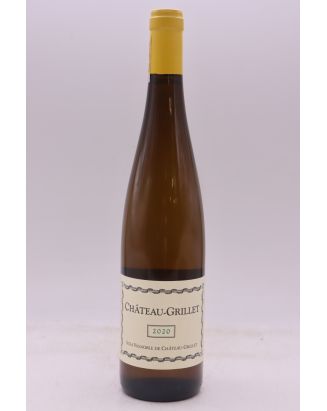
Chateau Grillet

One of the stars of the Rhône

Château Grillet wines: buy at the best price

Château Grillet, a tiny 3.5-hectare vineyard in the Northern Rhône, is a monopole appellation producing an average of 10,000 bottles per year today. It is said that Emperor Probus planted the very first vine plots of Château Grillet in the 3rd century, using cuttings brought from Dalmatia. Consumed by Empress Joséphine (wife of Napoleon), in 1936 the owner Henri Gachet obtained recognition of the Château Grillet controlled designation of origin, which was at the time one of the smallest in France. Château Grillet was sold in 2011 to François Pinault, by the Neyret Gachet family who had owned it since 1827. 

Read more
See more
Filters

Price

€340.00 - €360.00

Vintage

Volume

Parker WA rating

87 - 98

Burghound rating

No choice available on this group

Revue du Vin de France rating

No choice available on this group

Bettane & Desseauve rating

16 - 17

Prices drop

No choice available on this group

Download this list
There is 1 product.
Download this list
Château Grillet 2020
0 in stock
113054
White
75cl
Out of stock
Rhône | Château Grillet

Château Grillet 2020

€354.00 inc-VAT per bottle
€295.00 ex-VAT

History of Château Grillet

The origins of Château Grillet reach back to antiquity. Legend credits Emperor Probus with bringing vines from Dalmatia to these hillsides in the third century. The slopes were literally scorched by the sun, giving the place its name. Over the centuries, the estate passed into the hands of bourgeois families from Lyon and became a refuge for brilliant minds: the geometer Girard Desargues, an adviser to Richelieu, retired there in 1648, and the philosopher Blaise Pascal stayed there in 1652. By the late 18th century, the wine was served at Europe's finest tables. Thomas Jefferson visited the property in 1787; an 1814 inventory of the Malmaison cellar recorded nearly 300 bottles of Château-Grillet belonging to Empress Joséphine; and James Christie purchased some in 1829 on behalf of King George IV.

The estate was among the first in the Rhône to vinify, bottle and sell its own wines, beginning in 1830 under the stewardship of the Neyret-Gachet family, who would retain it for nearly two centuries. In the 20th century, chef Fernand Point, the first to earn three Michelin stars and the man behind La Pyramide in Vienne, became one of its most ardent champions. The critic Curnonsky, the “prince of gastronomes,” included the wine in his famous group of the world's five greatest white wines, alongside Montrachet, Coulée de Serrant, Château d’Yquem and Château Chalon. The Château-Grillet appellation d’origine contrôlée was recognized in 1936, making it one of France's smallest and most prestigious appellations, nestled within Condrieu. In 2011, its acquisition by the Pinault family opened a new chapter: major investment, terrace restoration, conversion to organic farming (certified since 2016) and highly precise winemaking under the overall direction of Frédéric Engerer, with Aloïs Houeto at the helm of the property.

Terroirs and Vineyards of Château Grillet

The vineyard is laid out across 102 terraces supported by dry-stone walls, known locally as chaillées, at elevations of 150 to 250 meters. This natural amphitheater, facing due south and sheltered from northerly winds, enjoys an exceptional microclimate that concentrates light and warmth while the nearby river keeps nights cool. The slopes, often dizzyingly steep, rule out mechanization and require all work to be done by hand.

The poor, free-draining soil consists of weathered biotite granite, sometimes covered by thin layers of loess. By rooting deeply in the weathered rock, the vines can reach underground water reserves and withstand dry summers with less water stress. Viognier, the estate's only grape variety, has found its kingdom here: this variety, which nearly disappeared in the 1960s, owes part of its survival to Château Grillet's steadfast commitment to it. With forests bordering a quarter of its area, the estate pursues an agroforestry approach, planting almond, plum and peach trees, oaks, maples and lindens along the edges of and within its plots. It also installs birdhouses and bat roosts; more than 130 species of birds, insects, amphibians and mammals have been recorded in its ecosystem.

Winemaking at Château Grillet

It all begins in the vineyard, with single Guyot pruning that respects the flow of sap, soils worked mostly by hand, and plant- and mineral-based preparations drawn from biodynamic practices. The grapes are harvested at peak ripeness into small crates, following meticulous sorting directly on the terraces by a core team of four people who work year-round.

In the winery, grapes from each plot are gently pressed and vinified separately, allowing fermentation to be tailored to each lot and preserving the character of each exposure. The wine then spends 18 months aging on fine lees in barrels, with a deliberately low proportion of new oak (around 20% at most) so as never to mask the expression of the terroir. The highly selective final blend shapes the character of the vintage: it is this pursuit of balance among richness, tension and salinity, rather than the aromatic exuberance often associated with Viognier, that defines the house style.

The Wines of Château Grillet

Château-Grillet: the fine wine at the heart of this single-estate appellation is pure Viognier from the estate's finest granite terraces. It reveals itself slowly and with restraint, showing finely etched minerality often accompanied by a marine, saline freshness, sometimes with hints of mint. The complex, evolving nose combines floral notes (rose, violet, linden blossom), white and tropical fruits (pear, pineapple, apricot), then develops hints of honey, hazelnut, saffron or white truffle over time. The full-bodied, energetic palate brings together richness, a delicate, refined bitterness and vibrant salinity, with remarkable depth. Made in very limited quantities and built to age, it comes fully into its own after about ten years and can be cellared well beyond that. It pairs with the most refined dishes: asparagus, truffled foie gras, turbot, braised lobster, Bresse poultry, subtly spiced Asian cuisine or Rigotte de Condrieu, a small local goat cheese.

Côtes-du-Rhône (formerly Pontcin): created in 2011 when Artémis Domaines took over, this second wine comes from the estate's young vines and a rigorous selection of neighboring plots, also planted with Viognier. It offers a more immediately appealing, fruit-forward expression of the site, with vivid fruit, notes of white flowers and citrus, and refreshing tension on the finish. Its texture remains subtle and complex, marked by an elegant, mouthwatering minerality that speaks to its granite origins. Enjoyable while young yet with genuine aging potential, it pairs well with sea bass fillet, Mediterranean salad, goat cheeses or sushi.

Condrieu La Carthery: first produced in 2017, this rare cuvée comes from twelve terraces adjoining those of the château, planted on approximately 0.25 hectares of granite soil high on the slope in the Condrieu appellation. It reveals another side of Viognier, more generous and full-bodied, without ever losing its focus or balance. Vinified with the same exacting precision as the fine wine and patiently aged on fine lees, it is expressive, savory and distinctive, enjoyable in its youth or after a few years in the cellar. A limited-production wine that naturally completes the property's trio.

WHAT THEY SAY ABOUT US

5 good reasons to buy wines on V&M

...

EXPRESS DELIVERY

In a secure polystyrene packaging

...

INTERNATIONAL SHIPPING

Find out more about VAT-EX sale for outside EU deliveries

...

COLLECTION NEAR PARIS & VAT REFUND FOR TOURISTS

Free collection in our warehouse near central Paris (92)

...