Personalise your experience
Change your country, language and currency here whenever you wish.
|
|
|
Must-See Châteaux |
|
|
|
|
|
|
At the heart of the Aube, in the little-known yet fascinating Côte des Bar vineyard, Domaine La Borderie embodies a new generation of Champagne winegrowers resolutely rooted in their terroir. Officially established in 2013, this small 11.5-hectare family estate situated around Bar-sur-Seine sets itself apart through a philosophy as clear as its wines: respecting the vine, showcasing each plot, and crafting Champagnes of exemplary precision and honesty. Certified Haute Valeur Environnementale (HVE) and Viticulture Durable en Champagne from its earliest years, the estate embodies a responsible and committed approach to viticulture, where biodiversity is preserved and living ecosystems are respected at every stage.
The history of Domaine La Borderie is first and foremost that of a family deeply rooted in the vineyards of the Aube. Odile and Jean-Louis Normand had been making champagne for many years, but solely as members of the local cooperative. For decades, their grapes supplied the great négociant houses, like so many growers from the Côte des Bar. Their grandparents had been among the first cooperative members in the region.
Everything changed in 2013 when their children, Simon and Marie Normand, decided to take over the family estate and write a new chapter. Simon Normand first completed a BTS in nature management and protection before undertaking training in viticulture and oenology and doing an internship in Burgundy at Bouchard Père et Fils. This Burgundian experience, in a region where Pinot Noir reigns supreme, gave him a particular sensitivity for plot-level expression and oenological precision. Simon began his training in 2008, working for the cooperative to which his parents sold their grapes, then joined Bouchard Père et Fils in Beaune for three years, followed by a stint at Domaine Fleury, a benchmark Champagne producer.
In October 2015, the dream became reality with the official inauguration of the new winery-cellar, a building designed to combine technical modernity with integration into the natural landscape. The name "La Borderie" is not without meaning: historically, this term referred to a small farm, and that is essentially what they are — an estate that does not purchase grapes from outside. This name also reflects the Burgundian influences that guide the estate's approach, where the identity of each plot is at the heart of every decision.
Today, it is a new generation, Marie and Antoine, who continues the family adventure by crafting cuvées that reflect the typicity of their terroir and express their personality.
Domaine La Borderie is located in Bar-sur-Seine, in the Champagne vineyard of the Côte des Bar, more specifically in the Bar Séquanais, at the confluence of the Seine and Arce valleys. This Aube vineyard, often described as the poor relation of Champagne, actually harbours terroirs of exceptional geological richness, very different from the chalks of the Marne.
The vines are planted on a terroir whose soils were formed between 152 and 142 million years ago, during the Jurassic period, and essentially during the Middle and Upper Kimmeridgian, composed of three layers of grey marls separated by two layers of marly to hard limestones, for a total thickness of around 80 metres. These Kimmeridgian argilo-calcareous soils, the same as those found in the great vineyards of Chablis and Sancerre, lend the estate's champagnes their characteristic mineral tension and their chiselled freshness.
The estate has 11.5 hectares of vines spread across seven villages around Bar-sur-Seine. Only 1.5 hectares are dedicated to the estate's own production, the rest being delivered to the cooperative. The average age of the vines is around 30 years, with four grape varieties cultivated: the three major grape varieties of Champagne, Pinot Noir, Chardonnay and Pinot Meunier, to which the rare Pinot Blanc is added. The vineyard is planted 70% in Pinot Noir, complemented by Chardonnay, Pinot Meunier and Pinot Blanc, and farmed without herbicide or insecticide.
The estate's environmental approach goes well beyond certifications. The estate is moving towards agroforestry: the planting of hedgerows and trees at the heart of the plots encourages the development of a local ecosystem and the protection of the vines, by providing a refuge for beneficial wildlife such as birds and insects. As a result, around thirty nesting boxes for birds and bats can be found throughout the vineyard. Simon Normand thinks in terms of micro-terroirs, analysing each plot individually to better understand what unique contribution it can make to the glass.
If the philosophy in the vineyard is rooted in respect for living things, that of the winery is rooted in precision and terroir truth. The very modern winery was designed to allow plot-by-plot vinification with the aim of producing gastronomic champagnes. The grapes, once harvested, are immediately pressed in order to preserve the aromatic integrity of the berries.
The winery is ultra-modern, operating by gravity, and each batch is vinified separately, which makes it possible to preserve the individual identity of each plot through to the final blend. The various cuvées contain only 5 to 15% of wines aged in oak barrels. The house style is one of absolute precision, great clarity and magnificently fruit-driven. The wines fermented in stainless steel tanks undergo malolactic fermentation, while in barrels it is avoided. This deliberate choice preserves the natural vivacity and tension of the wines, avoiding any heaviness or flabbiness.
The dosage chosen is systematically very low, Extra Brut at 3 g/l, a sign of controlled ripeness in the vineyard and a pursuit of authenticity in the expression of the terroirs. The reserve wines, some of which are kept in solera, bring depth and stylistic continuity from one year to the next. Cellar ageing takes place on lees for a minimum of 24 to 30 months depending on the cuvée, allowing perfect integration of the mousse and the development of tertiary aromas.
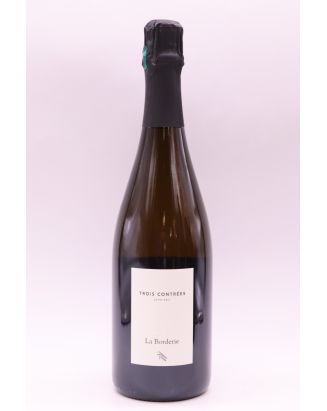
Trois Contrées
The Trois Contrées cuvée represents the estate's trilogy: 3 grape varieties, 3 villages, 3 terroirs and 3 expositions. It is the entry-level cuvée, the most faithful portrait of what La Borderie seeks to express. The blend is composed of 70% Pinot Noir, 20% Chardonnay and 10% Pinot Blanc, sourced respectively from the villages of Merrey-sur-Arce, Ville-sur-Arce and Bar-sur-Seine, three distinct villages of the Côte des Bar. The base wine comes from the 2021 harvest, complemented by 15% reserve wines. The vinification is partially carried out in oak barrels for the Pinot Noir, while malolactic fermentation takes place in stainless steel tanks. The wine is aged on lees for at least 24 months before disgorgement, with an Extra Brut dosage of 3 g/l.
Douce Folie
The grapes used for this rosé come from the "Douce Folie" vineyard, whose old Pinot Noir vines of over 50 years are used for this rosé crafted by the maceration method (saignée), in order to achieve a deep and intense colour. The plot is located in Merrey-sur-Arce. The grape variety is 100% Pinot Noir, with an Extra Brut dosage. The light, moderately deep rose-petal robe heralds an expressive, fine and delicate nose. The nose reveals floral notes of violet, fresh fruits, raspberry, blackcurrant, morello cherry, and mineral notes, for an expressive, fine and delicate bouquet. The palate opens with subtlety, with a creamy effervescence, flesh, acidity and fruit.
De Quoi Te Mêles-Tu?
Behind this facetious name lies a fine winemaking story. The grower who planted Pinot Noir on a clay soil with a north-facing exposure was mocked by his neighbours. "What business is it of yours?" was their reaction, and that is the cadastral name of this plot. Simon Normand chose to pay tribute to it by making it an exceptional single-plot cuvée. This Blanc de Noirs, all elegance and purity, is crafted from the Pinot Noirs of the "De Quoi Te Mêles-Tu?" plot located in Neuville-sur-Seine. The vinification includes 15% wine aged in barrel without malolactic fermentation and 85% fermented in stainless steel tanks with malolactic fermentation. The ageing on lees lasts 2.5 years, with an Extra Brut dosage of 3 g/l.
La Confluente
La Confluente is a vintage Blanc de Blancs from 2 plots in 2 valleys: Pinot Blanc from the Seine valley (20% of the blend) and Chardonnay from the Arce valley (80%). Its name evokes the confluence of these two valleys that shape the viticultural landscape of the estate. Its aromatic profile is of great finesse: on the first sip, the cuvée is round, but the same La Borderie touch, delicate and taut, then draws the wine back onto a beautiful mineral framework. The Pinot Blanc, even in small proportion, contributes a uniquely pulpy and crunchy texture that cannot be found in any other champagne in the region. The nose is floral, fresh and indulgent, with notes of white flowers, honey, white peach and a mineral touch. The palate is tonic and slightly citrusy, with a hint of minerality on the finish.
Coteaux Champenois Les Dévoix
There are rare wines that are not made every year, and "Les Dévoix" is one of them. When the Pinot Noir grapes from the old vines reach beautiful ripeness, Simon and Marie craft this still red wine, "a small rarity that we do not make every year". The "Les Dévoix" plot is very long, between 800 and 1,000 metres, running alongside a departmental road; the estate has two completely opposing parts on this terroir, which lends this Coteaux Champenois a remarkable complexity. This red wine from Champagne, unclassifiable and confidential, bears witness to the Burgundian dimension of the Aube terroirs and to the technical mastery of Simon Normand, trained in contact with the great Pinot Noirs of Burgundy.
COLLECTION NEAR PARIS & VAT REFUND FOR TOURISTS
Free collection in our warehouse near central Paris (92)