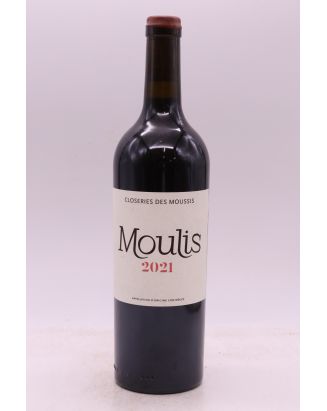
Closeries des Moussis Moulis 2021
Personalise your experience
Change your country, language and currency here whenever you wish.
|
|
|
Must-See Châteaux |
|
|
|
|
|
|
Les Closeries des Moussis is a micro-estate in the Haut-Médoc, in the southern part of the Bordeaux vineyard, founded in 2009 by two passionate women, Pascale Choime and Laurence Alias. Cultivated using organic farming and biodynamics (Demeter certification), these rare wines captivate with their freshness, finesse, and natural character, far from oaky and standardized profiles. Across just a few hectares, the estate produces delicate and easy-drinking cuvées that reconcile wine lovers with the wines of the Médoc.
The adventure of Les Closeries des Moussis began in 2009, near Arsac, in the southern Médoc, at the initiative of two women united by wine and nature. Pascale Choime, an oenologist with an artist's soul, had been cellar master at a Médoc cru bourgeois for over twenty years, while Laurence Alias, an agricultural engineer, has long been committed to ecology and sustainable development. The encounter with a very old pre-phylloxera vine sealed this shared project, whose name evokes the wild plum trees of the region.
Starting from barely one and a half hectares in the Haut-Médoc appellation, the estate expanded with a plot in Margaux in 2015, then reached approximately four and a half hectares from 2020 onwards. Committed very early to an ecological approach, the vineyard is farmed organically (certified in 2012) and then biodynamically (Demeter certified in 2015), a rarity in the Médoc.
The vineyard extends across the southern Médoc, on the Sénéjac plateau (commune of Le Pian-Médoc), at Cantenac in the Margaux appellation and, more recently, in Moulis-en-Médoc. The vines take root in complementary terroirs: sandy gravels on a clay subsoil, clay-silt soils and black sands. Most are thirty to forty years old, planted at very high density (10,000 vines per hectare).
The jewel of the estate is a pre-phylloxera plot of over one hundred and fifty years old, ungrafted, where six Bordeaux grape varieties are co-planted. The rows are grass-covered, with no herbicides or pesticides, and all work is done by hand. Ploughing is carried out by Jumpa, the draught horse, in order to preserve the soils. Yields are deliberately kept low, as a guarantee of concentration and purity.
At the Arsac winery, vinification is natural and respectful of the grape. The harvest, gathered by hand in small crates, is fully or partially destemmed depending on the vintage. Fermentations are started exclusively with indigenous yeasts, with gentle extraction by pigeage. No oenological inputs are added, except for a minimal dose of sulphur when necessary, the 2018 vintage having even been produced without sulphur.
Ageing favours non-new barrels, complemented by singular vessels such as amphora. The wines are not fined and are barely filtered. The result is wines that are alive, fresh and airy, as close as possible to the fruit, a world away from the over-extracted or over-oaked cuvées the appellation has sometimes produced.
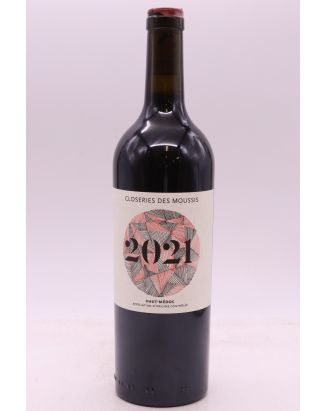
Closeries des Moussis (AOC Haut-Médoc, red) is the estate's flagship cuvée, from the Sénéjac plateau. Dominated by cabernet sauvignon and complemented by merlot and cabernet franc, it is aged for around twelve months in non-new barrels. Fine and elegant, it unfolds ripe black fruits, a mentholated freshness and spices, on melted tannins with a fine capacity for ageing.
Le Luquet (AOC Haut-Médoc, red) comes from a terroir of black sands. More immediately approachable and thirst-quenching, this cuvée plays on crunchy fruit and indulgence. Supple and fresh, it can be enjoyed from its youth and offers an ideal introduction to the world of the estate.
Baragane (AOC Haut-Médoc, red) is the estate's rare and exclusive cuvée, born from the pre-phylloxera plot of very old ungrafted vines, co-planted with six grape varieties. Its minuscule yield delivers only a few hundred bottles. Powerful and deep, it mingles black fruits, leather, undergrowth and pepper, on structured tannins that call for patience. Its name evokes the wild leek growing between the vines.
Margaux (AOC Margaux, red) is born from a plot taken over in Cantenac. Of great elegance, it is distinguished by its aromas of black fruits and Earl Grey tea, enhanced by perfectly integrated oak. The palate, ample and deep, gains in nobility after a few years of ageing.
Moulis (AOC Moulis-en-Médoc, red) was born from a plot taken over in 2020 and converted to biodynamics. This cuvée explores a new Médoc terroir and extends the house's signature: a fresh, straight wine true to its fruit.
Virevolte (Vin de France, red) belongs to the convivial wines produced from organic grapes. With no added sulphur, predominantly merlot and aged for only a few months, it seduces with its crunchy fruitiness, its indulgent character and its spiced notes, to be enjoyed in its youth.
Spoum (natural sparkling rosé) is a festive sparkling wine blending merlot and cabernet franc. Lively and thirst-quenching, it embodies the joyful and spontaneous side of the estate, perfect as an aperitif.
Gisèle, a deep and indulgent clairet, reveals notes of red fruits, cocoa and gentle spices. Carried by a lovely freshness and a crunchy juice, it is a fluid and easy wine to share.
Lhasa (dry white wine) is produced from sémillon sourced from an organic vineyard in the Entre-deux-Mers. Aged for three years in a large barrel without topping up, it develops a singular oxidative profile, deep and long, for lovers of characterful white wines.
Sparrows completes the range with a rare red cuvée, produced in very small quantities depending on the vintage. It illustrates the plot-by-plot work and the freedom of these two winemakers devoted to the natural wines of Bordeaux.
COLLECTION NEAR PARIS & VAT REFUND FOR TOURISTS
Free collection in our warehouse near central Paris (92)