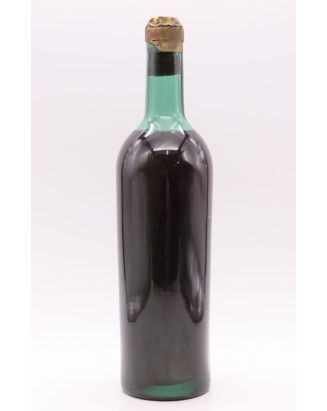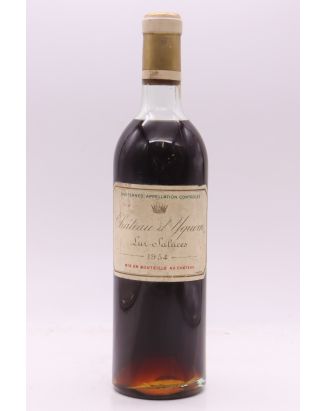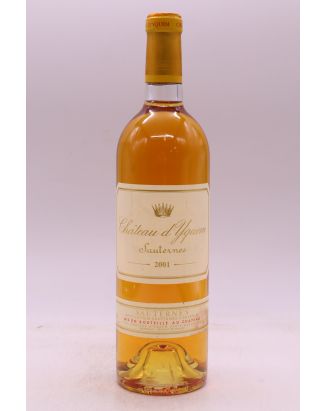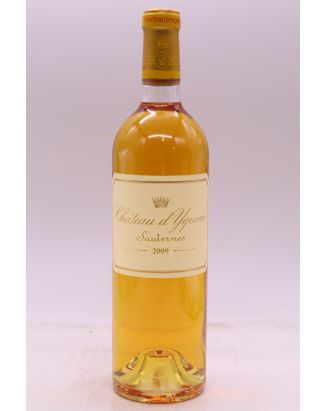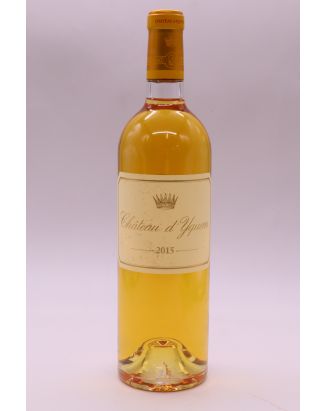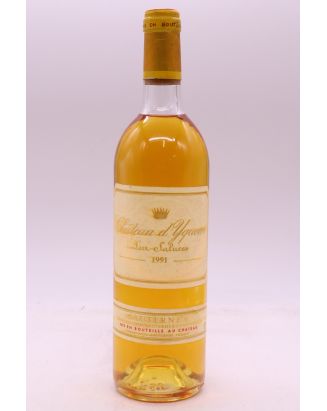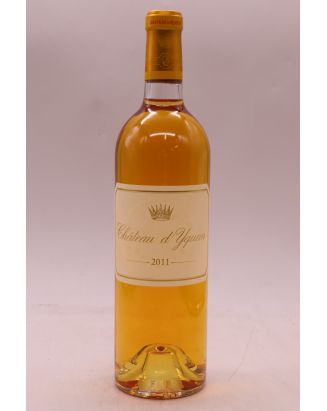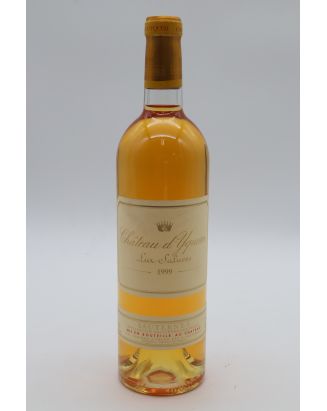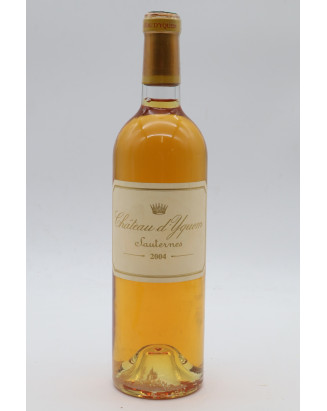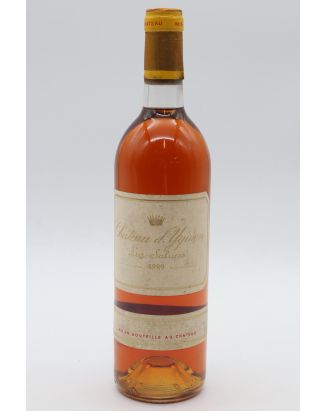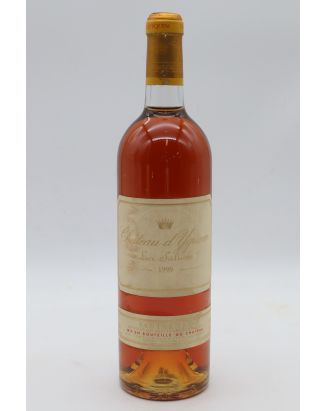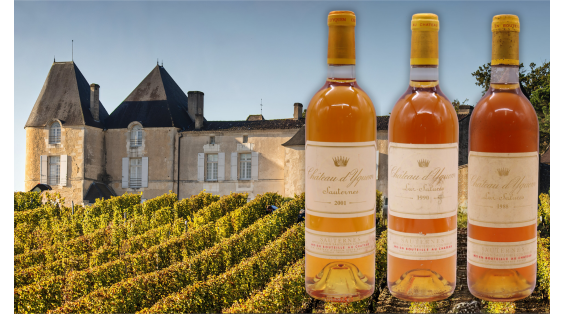
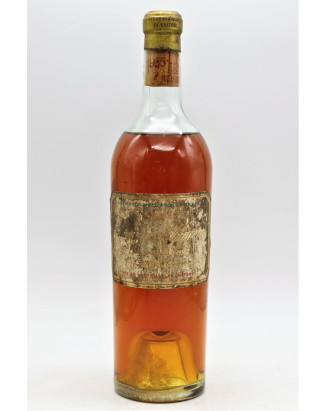
Yquem 1941 -10% DISCOUNT !
Yquem 1991 -5% DISCOUNT!
Château d'Yquem occupies a completely unique place in the world of sweet wines. It is the only estate in the Sauternes appellation to have been awarded the rank of Premier Cru Supérieur in the 1855 classification, a distinction that no other château has ever matched. This recognition stems from the unique combination of its terroir — clay-gravel soils perched on a hillock overlooking the Garonne — and an absolutely rigorous harvesting method. The teams at Château d'Yquem walk each row of vines up to eight to ten successive passes, picking only the berries affected by noble rot (Botrytis cinerea) at the optimal level of concentration. The result is a wine of unrivalled aromatic richness, length on the palate, and ageing potential within the category of sweet white wines.
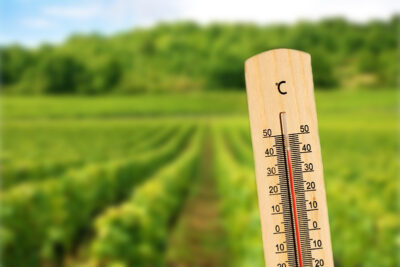
Château d'Yquem is best enjoyed slightly chilled, between 10 and 13°C, in a generously sized white wine glass to allow the aromas to fully express themselves. In appearance, its golden robe with amber highlights already hints at the richness of the nose, where candied apricot, acacia honey, vanilla, saffron and toasted notes intertwine. On the palate, the balance between residual sugar and lively acidity is its signature. For food pairings, the classics remain unrivalled: pan-fried or semi-cooked foie gras, Roquefort, apple tarte tatin or lobster with cream. The more adventurous will pair it with spiced dishes or certain blue-veined cheeses to play on sweet-savoury contrasts.
While all Sauternes share the same botrytised harvest process, Château d'Yquem stands out for several fundamental reasons. First, its yields are the lowest in the appellation: on average, only one glass of wine is produced per vine, compared to a full bottle elsewhere. Second, in years deemed insufficient, the château does not hesitate to produce no Fine Wine at all, as was the case in 1972 and 1974 — an extremely rare decision that reflects an absolute uncompromising stance on quality. Finally, ageing in new oak barrels for three and a half years gives Yquem a structure and depth that its neighbours, excellent as they are, rarely achieve.
Several vintages of Château d'Yquem stand out as absolute references for great occasions. The 1959 is unanimously praised for its opulence and breathtaking complexity. The 1967 is often cited as one of the greatest Yquem vintages of the 20th century, with a concentration and freshness that defy time. The 1975 and 1983 are also exceptional vintages, combining power and elegance. More recently, the 2001 is considered by many experts to be a near-perfect vintage, offering a golden richness and remarkable acidity that guarantee exceptional longevity. These bottles will make for a memorable gift or an unforgettable tasting experience.
Château d'Yquem is one of the rare white wines in the world with an almost unlimited ageing potential. Under optimal storage conditions — a cellar at around 12°C, stable humidity, away from light and vibrations — a bottle from the greatest vintages can evolve serenely for 50 years or more. Bottles from the 1967 or 1959 vintage tasted today still display impressive vitality and complexity. For more recent vintages such as 2001 or 2005, experts recommend waiting several more years before opening the bottle, in order to enjoy the wine at its peak aromatic expression.
Yes, Château d'Yquem produces a second wine called "Y" d'Yquem, which differs radically from the fine wine by its very nature: it is a dry white wine, not a sweet one. Born in the 1950s from the same plots and the same grape varieties, Ygrec is made from grapes that have not reached the level of botrytised concentration required to be included in the fine wine. With a higher proportion of Sauvignon Blanc than in the main wine, it presents a lively and complex aromatic profile, with notes of citrus, white flowers and a pronounced minerality. Its production is confidential and irregular — in some years, it is simply not produced — making it a sought-after bottle for enthusiasts wishing to explore the world of Yquem from a different angle.
Yquem is the most famous and the greatest sweet wine in the world!
Owned by LVMH since 1997 (previously the Lur de Saluces family), Château d'Yquem is the only Premier Cru Supérieur classified in Sauternes and Barsac in the 1855 classification of Bordeaux wines, and produced no wine in 1910, 1915, 1930, 1951, 1952, 1964, 1972, 1974, 1992 and 2012. Located 45km from Bordeaux (left bank), next to Châteaux Guiraud, Rieussec, Clos Haut Peyraguey, Lafaurie Peyraguey and Raymond Lafon, the 100 hectares of the Yquem vineyard nestle at the top of the sandy-clay terrace, composed of a thin layer of sand over a clay dome.
Château Yquem is legendary and has had, since the 19th century, 100 km of buried pipework to drain rainwater. Approximately 35 years old, the vines grown using sustainable methods are composed of 75% Sémillon and 25% Sauvignon, and are planted at 7,000 vines per hectare.
The prestigious Château d'Yquem produces two white Bordeaux wines: the Fine Wine of Château d'Yquem and the second wine "Y d'Yquem".
It all began in the Middle Ages, when the estate belonged to the King of England, who was then Duke of Aquitaine. In 1453, Charles VII, having brought the region under the French crown, conferred upon the estate its current nationality. A century and a half later, in 1593, Jacques Sauvage, a local notable, became the tenant of Yquem and undertook the construction of the château. He gradually built up the current vineyard by acquiring it plot by plot. In 1711, ennobled under the reign of Louis XIV, the Sauvage family became the full owner of the Yquem estate. In 1785, the last heiress of the Sauvage d'Yquem family, Françoise Joséphine, married Louis Amédée de Lur-Saluces (colonel of a cavalry regiment). Following his accidental death, the estate passed to his widow, who developed the renown of the Yquem wines, already greatly appreciated by the leading connoisseurs of the time. Despite a difficult period during the Revolution, she succeeded in preserving the family heritage and making the property prosper. In 1826, she had the cellar built, a bold innovation for the time, which transformed the estate into a true wine-producing enterprise and developed its international renown.
What was once a family estate gained international recognition thanks to Romain-Bertrand de Lur-Saluces, grandson of Françoise Joséphine, who succeeded her after her death in 1851. The estate was then elevated to the rank of premier cru supérieur at the Paris Universal Exhibition in 1855. During the second half of the 19th century, the estate enjoyed a long period of prosperity. In 1859, Grand Duke Constantin, brother of the Tsar, purchased a barrel of Yquem for 20,000 gold francs — an unimaginable price for the time. Moreover, Japan, during the Meiji era, discovered the pleasures of Yquem wine. After the death of Romain-Bertrand, the estate was taken over by his son Amédée de Lur-Saluces, then by his younger brother Eugène. This chapter in Yquem's history came to a close with the great phylloxera crisis and the First World War.
In 1914, Château d'Yquem was converted into a military hospital while Bertrand de Lur-Saluces, son of Eugène, fought in the trenches. At the end of the conflict, he resumed management of the estate for half a century. True to the philosophy of Yquem, he opposed the chaptalization of wine and defended family estates even during the crisis of the 1930s. As president of the Union des crus classés de la Gironde, he played a central role in defending the grand crus and contributed to the determination of the Sauternes AOC. He was also one of the main advocates of "château bottling", thereby guaranteeing authenticity. Called up again during the Second World War, he returned to find his estate preserved after having been a prisoner for two years, and continued to ensure its development until his death.
In 1966, Bertrand de Lur-Saluces designated Alexandre de Lur-Saluces, one of his brother Amédée's sons, as his successor at the head of the estate. Despite a difficult start marked by a series of poor years, a severe trade crisis and significant inheritance taxes weakening Yquem, the estate was saved by better management and an excellent 1975 vintage. During the 1980s, better harvests allowed for new investments, reaching an even higher level of exacting standards and technical expertise than in the past.
Château d'Yquem was acquired in 1996 by the LVMH Moët Hennessy-Louis Vuitton group. In 2004, management was entrusted to Pierre Lurton, who has since continuously promoted its modernity, authenticity, and expertise while remaining open to the present day.
Here is a paragraph explaining the success of Yquem, the most famous sweet wine in the world!
For 100 years, it has been the sole Premier Cru Classé of Sauternes: it stands apart through its extreme quality and exemplary consistency, even in more difficult vintages. It produces only prodigious wines, which accentuates its status as a mythical wine. Indeed, in order not to compromise the exceptional quality of this estate, the domaine allows itself not to always produce its wines depending on the quality of the vintage.
This is a wine to be tasted at least once in one's lifetime!
Under the direction of Pierre Lurton (also director of Cheval Blanc), this marvellous Sauternes draws its excellence from its terroir and all the expertise that surrounds it.
Thanks to a terroir where botrytis develops under the best conditions, the wines produced are powerful, concentrated, with an ageing potential unmatched by their neighbours.
Botrytis cinerea is a fungus that develops and pierces holes in the skins of the grape berries. It is often considered a parasite responsible for grey rot, but when its development occurs under very precise conditions, the resulting rot is referred to as noble rot.
For this to occur, the berries must have already reached a certain level of ripeness, and the morning mists that facilitate the development and growth of botrytis must spread in the morning and dissipate in the afternoon, so as to limit the rate of infection and extend the ripening of the berries until harvest. Furthermore, the vineyard soils are composed of large gravel stones, favouring heat accumulation and drainage of rainfall, all with the aim of achieving berry ripeness.
Thus, the holes pierced under such conditions allow the water present in the grape berries to drain away: this process concentrates the flavours and sugars.
Such conditions are therefore precise and complex: the terroir of Yquem is fortunate to benefit from this microclimate thanks to the Ciron river, which generates morning mists and is often sunny in the afternoons.
A myth in its own right, with high prices, but something to truly delight in and leave a lasting impression.
The cultivation method at Yquem remains traditional. The soil is enriched with farmyard manure, on only 20 hectares per year, which helps maintain the natural balance of the soil. The vines are never chemically weeded, but are constantly tended by winegrowers in accordance with traditional cultivation methods, such as hilling and de-hilling. In winter, severe pruning encourages maximum ripeness. The Sémillon is pruned "à cots" while the Sauvignon is pruned "à cots" for 90% and in "guyot simple" for the remainder. The female winegrowers, for their part, look after the plots and carry out "green" operations such as desuckering, shoot lifting and de-budding. Before the harvest, the teams carry out leaf removal so that the bunches dry more quickly in the morning while protecting the west-facing side.
The next step is the harvest, a method unchanged at Château d'Yquem. The botrytis contaminates the berries, turning them brown and making the skin permeable, which allows water to evaporate and sugar to concentrate inside. The must thus reaches levels well beyond normal ripeness, with a potential of 18 to 30° of alcohol, equivalent to 300 to 600 grams of sugar per litre. The objective is to obtain a must at 20° potential alcohol, which requires a long wait and a significant risk of crop loss as winter approaches. Yquem's low yield (9 hectolitres per hectare on average) is explained by the reduction in volume due to this concentration. Then, 200 pickers, organised into 4 teams, comb the vineyard in search of "botrytised" grapes that have reached their optimum concentration. The picking requires several successive passes to harvest only the "roasted" grapes transformed by noble rot. Spread over 6 weeks, this harvest requires an average of five to six passes, and sometimes more than ten in certain years.
From vine to cellar, everything begins with pressing, adapted to the texture of the berries. Unlike other white wines, three to four pressings are carried out at Yquem to increase the sugar content and the quality of the juice. The first pressing, carried out in a pneumatic press, yields 75% of the juice with approximately 19° potential alcohol. The second pressing represents 15% of the juice at approximately 21°, and the third can reach 25°. The juice is then returned to a vertical press for a final drying. Fermentation takes place in barrels, with new barrels traditionally made from oak staves. Each barrel is identified and the batches are monitored daily by the château's laboratory. Fermentation can last from two to six weeks depending on the activity of the musts. Each day's harvest is vinified separately for 6 to 8 months. A pre-blend is carried out among the batches the following spring after the harvest, then the wine spends 20 months in the ageing cellar, with 15 rackings to eliminate deposits. Fine suspensions are removed by a light "fining". The final selection is made through blind tastings to decide on the final blend of Château d'Yquem.
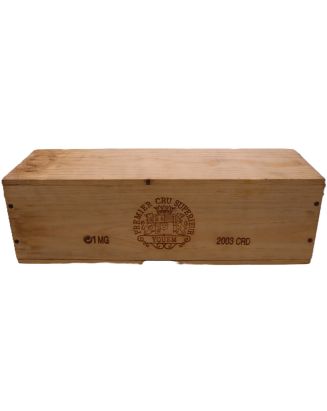
The final step is bottling. During the third winter, the wine is bottled under the best technical conditions, with a 54 mm cork to ensure its exceptional ageing potential. Yquem offers various bottle formats, from the half-bottle to the Nebuchadnezzar. Once bottled, the presentation is meticulous: label, capsule, the bottle is wrapped in white tissue paper and placed in a wooden case, in crates bearing the château's coat of arms.
The wine produced thus has a golden colour and displays a magnificent aromatic palette.
In great vintages, the fine wine Yquem is very opulent, rich, powerful, unctuous and full-bodied, with hints of orange marmalade, pineapple, apricot, peach, crème brûlée, spices and coconut. A silky texture and an enveloping sensation that coats the palate, this nectar offers a magnificent balance between sweetness, opulence, freshness and acidity, all with a pronounced intensity of flavours!
With its exceptional length, one must wait a minimum of 15 years before approaching it, but it can age for up to 100 years depending on the vintage. The Fine Wine is luxuriously aged in new oak barrels for 42 months.
The greatest vintages of Yquem, with scores above 96/100, are: 2015, 2014, 2013, 2011, 2010, 2009, 2007, 2006, 2005, 2003, 2001, 1997, 1990, 1989, 1988, 1986, 1983, 1976, 1975, 1967, 1959, 1955, 1949, 1947, 1945 and 1937. Yquem has received a perfect score of 100/100 from Parker 8 times, in: 1811, 1847, 1921, 1945, 1975, 1976, 2001 and 2009. The reviews of Château d'Yquem are fabulous, with 3 stars in the RVF Green Guide, and the prices are commensurate with this iconic fine wine with its incredible ageing capacity.
The prices of Château d'Yquem bottles from the previous century are very high for several reasons, which contribute to the reputation and value of this exceptional wine:
History and Prestige: Château d'Yquem is one of the most prestigious and ancient wine estates in the world. Its history dates back to the Middle Ages, and it was classified as Premier Cru Supérieur at the Universal Exhibition in Paris in 1855, a unique distinction in the classification of Sauternes wines. This historical recognition and its prestige contribute to its value.
Quality and Singularity: Yquem is renowned for its exceptional quality. The production of this wine is marked by unparalleled rigour and attention to detail. The estate uses very precise winemaking and ageing techniques, and the harvest is carried out by hand, selecting only grapes affected by noble rot (botrytis cinerea). This laborious and delicate process ensures a unique concentration of sugar and aromas.
Longevity: The wines of Château d'Yquem are known for their exceptional ageing capacity. They can improve over several decades, or even more than a century, developing remarkable complexity and depth over time. This longevity makes Yquem wines highly sought-after collector's items.
Limited Production and Low Yields: The production of Yquem is deliberately limited to maintain quality. Yields are very low, approximately 9 hectolitres per hectare, which is well below the average of other vineyards. This rarity increases the value of the bottles.
International Reputation and Demand: Château d'Yquem enjoys an international reputation and is highly sought after by wine lovers and collectors from around the world. Demand for these wines is always high, which drives prices upward.
Exceptional Vintages: In certain years, climatic conditions and the terroir allow for the production of exceptional vintages. These vintages are particularly sought after and can reach very high prices. Wine lovers often seek out specific years known for their extraordinary quality.
Auction Success: Yquem wines frequently achieve record prices at auction, reinforcing their reputation as a safe investment and a solid asset.
In summary, the high prices of Château d'Yquem bottles from the previous century are explained by its prestigious history, its exceptional quality, its ageing capacity, its limited production, and its international demand. These factors make Yquem a safe investment for wine lovers and investors alike.
When opening a bottle of Yquem, care must be taken to ensure it is an optimal experience.
It will be necessary to open the bottle a little in advance to allow the wine to open up: 1 to 2 hours before tasting, to be enjoyed chilled at around 10°C. The taster should take their time to allow the wine to express its full aromatic palette. It is also worthwhile spending time describing its colour, the aromas that emerge on the first and second nose, as well as fully appreciating its flavours and texture on the palate, either on its own or by varying the dishes that accompany it.
Here are several tasting notes for various vintages of Château Yquem, carried out by our teams:
Yquem 2008: This is a wine one could appreciate for hours on the nose alone. White fruits, peach, pineapple, honey, crème brûlée, orange marmalade… Magnificent aromas for a 16-year-old Yquem! On the palate, the opulence, power, richness and unctuousness are balanced by a lovely freshness. The intensity of flavours is of course pronounced, and the length infinite. A true delight. Even for those who are not particularly fond of sweet wines or any form of sugar in wine, a small tasting alongside a dessert is sure to please everyone.
Y d'Yquem 1985: Deep golden colour with a few orange hues. The nose is rather unexpressive at first but opens up well after an hour of aeration. The aromas of a great sweet wine gradually emerge, followed by floral notes and dried fruits. The palate is unmistakably that of a dry wine, with a superb balance, a lovely acidity on a still very lively body for a dry white of this age. One could even wait for it!
Yquem 1985: Deep orange-gold colour, the most intense in the sequence. Honeyed and candied nose, with stewed white fruits and toffee. The palate is broad with medium acidity. The wine is undoubtedly the most evolved of the three in this sequence. The fragile cork of this bottle may be the cause of this rather premature evolution.
Yquem 1995: Golden colour with no perceptible orange hues. Nose of stewed orchard fruits, fruit paste, caramel and vanilla. The palate is of great power and the body massive, with reasonable acidity. A vintage with great ageing potential.
Yquem 1961: Deep orange-gold colour with amber hues. A very expressive and elegant nose, with honey, dark rum, beeswax, dried fruits, mushrooms and medicinal plants. The palate, however, is narrow with low concentration. Even though the superb level of the wine and the solid cork of this bottle left one dreaming, this old wine seduces primarily through its aromatics.
Yquem 1982: Deep orange-gold colour. One of the most seductive noses, featuring quince, orchard fruits, honey, flowers, dried fruits and bitter orange. The palate is magnificent — upright, well-balanced, with beautiful concentration and a wonderfully refreshing acidity. The finish is remarkable. A synthesis of the elegance and uniqueness of Yquem.
Yquem 1976: Deep orange-gold colour. Expressive nose of macerated fruits, honey, fruit paste and exotic fruits. A spherical, rich and massive palate that makes one want to wait many more years to enjoy it more fully.
Y d'Yquem 1979: A medium-intensity colour of gold/old gold. On the nose, aromas of wax, cream, very ripe exotic fruits, orange peel, mushroom and gentle spices. On the palate, the volume is significant, the acidity sustained with notes of smoke, undergrowth and earth. A slight bitterness on the finish.
Yquem 2002: The colour is of medium intensity, gold/old gold with no orange hues. The nose is intense with notes of pineapple, apricot, orange, vanilla and honey. On the palate, crème brûlée and orange peel come through, with a lovely acidity that leaves the palate clean over a great length.
Yquem 1958: A distinctly amber colour. The very complex nose reveals notes of cognac, coffee, tobacco, prune, "Quinquina", quince paste, mushroom, honey and bitter orange. The fine and subtle palate is nonetheless less complex than the nose. A lovely freshness with a shorter but reasonable length. Remarkable finesse for a wine of nearly 60 years that is still very much alive!
Yquem 1987: A fairly deep intensity, golden/old gold, more orange-hued than Yquem 2002. The nose, with notes of apricot, dried fruits, mushroom and quince, is of medium intensity. The harmony on the palate and the acidity/alcohol balance are remarkable, even if a slight bitterness is perceptible on the finish and the length is hampered by a hollow mid-palate.
Yquem 1995: A fairly deep intensity, a golden/old gold colour with orange hues, reminiscent of Yquem 1987. Very intense notes of bitter orange (significant botrytis), exotic fruits, candied citrus and some mushroom notes envelop the nose. On the palate, great amplitude, sustained acidity and considerable length dominate. A very significant reserve of life!
Yquem 1990: One of the most intense and most orange-hued colours. The nose reveals aromas of quince paste, ripe apricot, date and dried fig, evoking "fruits of the sun". An immense volume with a very sharp acidity on the finish, leaving the palate perfectly clean. Pronounced notes of orange peel and marmalade dominate throughout an endless length. Perhaps the wine of the evening…
When it comes to food and wine pairings for Yquem, you are spoilt for choice!
Simple dishes made with quality ingredients: Roquefort puff pastry, duck with honey and balsamic vinegar, roast chicken or another simple poultry dish, duck breast with peaches, lobster with mango sauce, a cassolette of scallops or another delicate white fish…
For desserts, you may opt for citrus notes that will perfectly complement the orange marmalade character of this nectar, while ensuring that the chosen recipe is not too sweet! Crêpe Suzette with flambéed orange, chocolate-dipped orange peel, pineapple tart, tarte tatin…
With a very high ageing potential, great care must be taken in storing Yquem so as not to… ruin everything. One must wait at least 15 years before tasting it and appreciating its tertiary aromas, linked to bottle ageing under perfect conditions. Here they are.
Wines must be stored on their side, away from light, temperature variations and vibrations, in a space with perfect humidity, outside their cardboard box and away from strongly scented products. Please also avoid any location subject to vibrations or tremors.
Please pay close attention to storage, so that on the day of tasting, everything is perfect!
The second wine of Yquem offers an aromatic palette of candied yellow fruits, quince, frangipane, gentle spices, and a touch of minerality. This wine comes from the same plots as Yquem, but was produced from 1959 to 1996 using non-botrytised grapes. Since 1997, the grapes are harvested fully ripe for the Sauvignon, and just before botrytisation for the Sémillon. This wine should be cellared for a minimum of 10 years to express itself fully.
Discover other great Sauternes wines such as Guiraud, Fargues, Sigalas Rabaud, Filhot, Rabaud Promis, Rieussec and Suduiraut!
For over 10 years, Vins & Millésimes has been offering you the opportunity to buy the finest bottles of aged wines and grand crus online, in stock and with fast delivery! Discover the bottles and magnums of Château d'Yquem available for purchase!
COLLECTION NEAR PARIS & VAT REFUND FOR TOURISTS
Free collection in our warehouse near central Paris (92)