Personalise your experience
Change your country, language and currency here whenever you wish.
|
|
|
Must-See Châteaux |
|
|
|
|
|
|
The expertise of the Cathiard family - Pomerol
Located in Pomerol, one of the most prestigious appellations of Bordeaux, Château Beauregard is a historic wine estate whose wines embody elegance and authenticity. With its exceptional terroir, its rich heritage dating back to the 12th century, and a deep commitment to organic farming, Château Beauregard is today an essential reference in the world of great Bordeaux wines.
The history of Château Beauregard dates back to medieval times, with origins rooted in the twelfth century. The estate was then under the stewardship of the Knights Hospitaller of Saint John of Jerusalem, a military religious order that left its mark on the history of the region with its emblem of the Templar Cross. This prestigious symbol remains an inseparable part of the estate's identity.
In the seventeenth century, the Beauregard family had a first building constructed on the site, which was later replaced at the end of the eighteenth century by the current château, a magnificent Gironde chartreuse. This imposing residence, with its dovecotes and moats — the work of a pupil of Victor Louis (architect of the Grand Théâtre de Bordeaux) — embodies the prestige and history of the estate. The estate also inspired a faithful copy, named "Mille-Fleurs", which the Guggenheim family erected in Port Washington, in the United States.
Château Beauregard then passed through the hands of various owners, each contributing to the evolution of the vineyard, notably by making viticulture the estate's primary activity from the mid-eighteenth century onwards. In 2014, the Moulin and Cathiard families acquired the estate, bringing major transformations while respecting the history and tradition of the Château.
The terroir of Château Beauregard is one of the most sought-after in Pomerol. This 17.5-hectare vineyard is situated on the south-eastern edge of the famous Pomerol plateau, benefiting from a unique soil composition dominated by gravel, complemented by clay and sand. This diversity of soils is ideal for cultivating noble grape varieties such as Merlot and Cabernet Franc, which thrive fully under these conditions, yielding wines that are at once rich, fresh and refined.
Particular attention is paid to each plot of the vineyard, with an intra-plot approach that makes the most of the specificities of each terroir. A detailed map has been drawn up to characterise the physico-chemical variations of the soils, and a constant effort is made to preserve and enhance biodiversity. Organic farming, adopted by the estate since 2009, is one of the cornerstones of this environmentally respectful approach.
The estate also favours traditional practices, such as horse-drawn ploughing in young plots and manual tillage, which respect the vitality of the soils. The objective is clear: to produce grapes of the highest quality while protecting this unique natural heritage.
Winemaking at Château Beauregard combines tradition and innovation. Harvesting is exclusively manual, carried out at optimal ripeness for each plot — and even on an intra-plot basis. Grape sorting is meticulous, with the use of cutting-edge techniques: selective sorting tables, high-frequency destemming machines and optical sorting ensure that only the finest grapes enter the vats.
The estate's facilities have been modernised with the creation of a new high-technology gravity-flow vat room, designed to ensure precise winemaking that respects the specificities of each plot. This vat room houses 22 truncated-cone raw concrete tanks, thermo-regulated and adapted to an extremely detailed plot-by-plot winemaking approach. Gravity filling preserves the integrity of the grapes, and alcoholic fermentations are regulated with precision between 25 and 30°C, depending on tannin extraction requirements.
For the finest lots, malolactic fermentation takes place in new barrels. The wine is then aged for 15 to 20 months in casks sourced from 7 different coopers, bringing complexity and finesse to each cuvée.
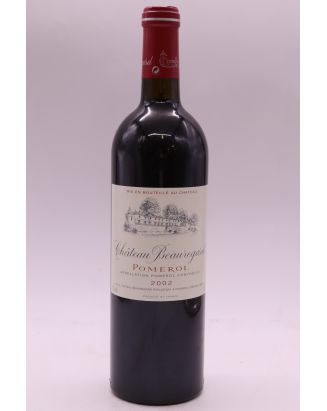
Château Beauregard
The estate's flagship wine, Château Beauregard, is a blend of 70% Merlot and 30% Cabernet Franc — grape varieties that find perfect conditions in the estate's gravelly and clay-sandy terroir to express their full complexity. This wine is distinguished by its freshness, elegance and fine tannic structure. Thanks to organic farming and respectful viticultural practices, each vintage fully expresses the exceptional terroir of Pomerol, offering aromas of ripe dark fruits, beautiful depth and a long ageing potential.
Château Beauregard is a wine crafted for aging, with its finest years falling between 15 and 20 years after bottling. Recent vintages, such as 2016, 2018 and 2020, are particularly remarkable, with increased purity and finesse thanks to the constant efforts of the estate's team.
Benjamin de Beauregard
The estate's second wine, Benjamin de Beauregard, is the result of strict plot selection, primarily from sandier soils. While benefiting from the same modern facilities as its elder sibling, this wine is designed for more immediate enjoyment, with more moderate extraction and a shorter maceration period. The barrel ageing is shorter, with only 30% new oak, which gives this wine more approachable aromas and an ideal suppleness on the palate for drinking within 3 to 10 years after the harvest.
Château Pavillon Beauregard
Château Pavillon Beauregard is a neighbouring property, also managed by the Moulin and Cathiard families, located in Néac within the Lalande de Pomerol appellation. This 12-hectare estate is planted with 75% Merlot and 25% Cabernet Franc, grown on a clay-gravel plateau. Since 2015, it has benefited from the same winemaking facilities as Château Beauregard, enabling it to produce a rich wine with silky tannins and a beautiful structure, perfect for ageing.
Pomerol, one of the most prestigious appellations of Bordeaux, has produced some of the finest wines over the decades. The most remarkable vintages include 1970, 1975, 1982, 1983, 1989, and 1990, celebrated for their complexity and longevity. Other exceptional years such as 1995, 1998, 2000, 2001, 2005, 2006, 2008, 2009 and 2010 continue to delight lovers of great wines. More recently, the vintages 2012, 2014, 2015, 2016, 2017, 2018, 2019, and 2020 have confirmed Pomerol's ability to produce wines of exceptional quality, further consolidating this appellation's reputation among the greatest of Bordeaux.
Discover the other great châteaux of Pomerol, true treasures of the right bank, where each estate vies for excellence. Beyond the mythical Pétrus, explore prestigious names such as Beauregard, Bon Pasteur, Clinet, Gazin, Haut Trochaud, L'Eglise Clinet, La Conseillante, La Fleur Pétrus, Lafleur, Le Pin, Latour à Pomerol, Nénin, Trotanoy, and Vieux Château Certan. These estates, often compared to the grands crus classés of Saint-Émilion, offer a unique experience, rich in finesse and character, sure to delight lovers of great wines.
Château Beauregard embodies both the historical heritage of Pomerol and modernity in its production methods. Thanks to the commitment of the Moulin and Cathiard families, the estate has successfully combined respect for tradition with technical innovation to produce wines of great finesse, while caring for the environment through organic farming. With a range of cuvées spanning from the prestigious Château Beauregard to its second wine Benjamin de Beauregard, as well as Château Pavillon Beauregard, this Bordeaux estate offers lovers of great wines a unique experience marked by elegance, freshness and depth. Whether you are a collector or an enlightened enthusiast, the wines of Château Beauregard will captivate you with their exceptional quality and their capacity to improve with age over the years.
COLLECTION NEAR PARIS & VAT REFUND FOR TOURISTS
Free collection in our warehouse near central Paris (92)