Saint Pierre 1979 -10% DISCOUNT !
Personalise your experience
Change your country, language and currency here whenever you wish.
|
|
|
Must-See Châteaux |
|
|
|
|
|
|
|
|
The smallest of the Classed Growths of Saint-Julien - Fourth classified growth
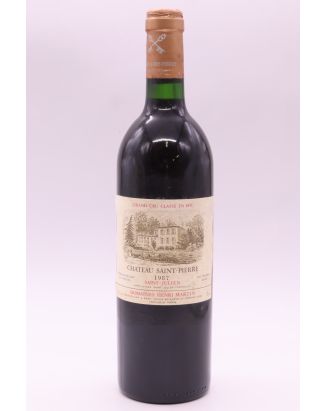
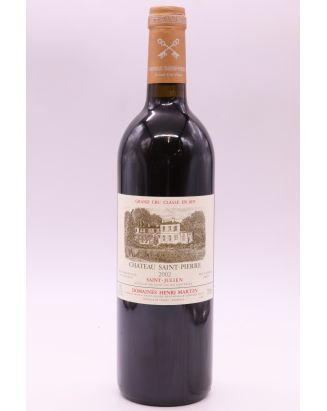
Château Saint-Pierre, a true reference among the Grands Crus Classés of 1855, stands out for its fascinating history, exceptional terroir, and viticultural expertise. Located in the heart of the Saint-Julien appellation, it is renowned for producing wines that combine elegance, complexity, and power, characterizing the unique style of this prestigious region of the Médoc. Although small in size, this estate has established itself through the exceptional quality of its wines, recognized for their perfect harmony between finesse and tannic structure.
Château Saint-Pierre traces its origins to the 17th century, a time when the lands of Saint-Julien were beginning to establish themselves as a renowned wine-growing area. Founded in 1693 under the name "Serançan", the estate was initially a property of the Cheverry family. In 1767, it was acquired by Baron Jean-Baptiste de Saint-Pierre, who gave it its definitive name, in keeping with the tradition of the era. Less than ten years later, the wines of Saint-Pierre were already recognized as among the finest in the region, ranked fourth in the commune by the wine broker Labadie.
It was as a Fourth Grand Cru Classé that the estate retained its status in the famous 1855 classification. However, the baron's death in 1832 led to the fragmentation of the estate, which was divided between his two daughters. This division persisted until the end of the 19th century, when the Van den Bussche family, Antwerp wine merchants, bought back both halves, thus beginning a process of reunification.
The true turning point for Château Saint-Pierre came in 1982, when Henri Martin, an iconic figure in the Bordeaux wine world, acquired the estate. Henri Martin, already the owner of the celebrated Château Gloria, set about restoring Château Saint-Pierre to its original configuration. Through his vision and tireless work, he succeeded in restoring the estate to its former prestige, patiently reconstituting its vineyard and modernizing it with state-of-the-art equipment. Today, the château is run by Jean-Louis Triaud, Henri Martin's son-in-law, who perpetuates the family tradition while keeping Château Saint-Pierre at the forefront of winemaking excellence.
Robert Parker awarded a score of 97/100 to the 2010 vintage of Château Saint-Pierre, highlighting the quality and elegance of this harmonious and powerful wine from the Margaux appellation.
The terroir of Château Saint-Pierre is one of the most remarkable in the Saint-Julien appellation. The 17 hectares of vines located on the left bank, though modest in size, benefit from the gravelly-sandy soils typical of the region, composed of Garonne gravels over a subsoil of sand and clay. These soils are particularly well-suited to the cultivation of noble grape varieties such as Cabernet Sauvignon, Merlot and Cabernet Franc.
The estate's grape variety composition reflects this exceptional terroir, with a predominance of Cabernet Sauvignon (75%), followed by Merlot (15%) and Cabernet Franc (10%). These proportions are ideal for producing wines that are at once powerful, balanced and elegant. The vines of Château Saint-Pierre average 50 years of age, which contributes to the concentration and complexity of aromas in the wines. The planting density of 10,000 vines per hectare encourages greater competition between the plants, thereby enhancing the quality of the harvested grapes.
The winemaking process at Château Saint-Pierre combines tradition and innovation, guaranteeing wines of outstanding quality while respecting the characteristics of the terroir. Following meticulous hand-harvesting, the grapes are transported to the neighboring Château Gloria to be vinified, in accordance with a long-standing agreement between the two estates.
Fermentation takes place in temperature-controlled stainless steel vats, ranging in capacity from 50 to 178 hectoliters, allowing for precise control of the process. Malolactic fermentation, for its part, is carried out in barrels to refine the tannins and add greater complexity to the wine.
The wine is then aged for 14 to 16 months in French oak barrels, approximately 60% of which are renewed each year. This judicious choice of aging adds a fine woody structure to the wines while preserving the fruity expression of the grape varieties. Although Château Saint-Pierre does not produce an official second wine, the young vines and certain declassified batches are incorporated into the second wine of Château Gloria, known as Peymartin.
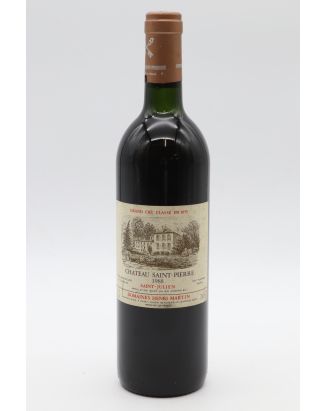
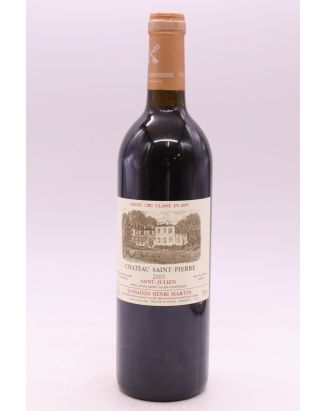
Château Saint-Pierre
The estate's flagship wine, Château Saint-Pierre, is one of the smallest yet most prestigious Grands Crus Classés in the Saint-Julien appellation. Its annual production is approximately 75,000 bottles. This wine is renowned for its depth and exceptional structure, combining power, complexity and elegance.
On tasting, Château Saint-Pierre stands out for its deep ruby color and its intense aromas of ripe red fruits, cedar and undergrowth. On the palate, it reveals a velvety texture with perfectly integrated tannins, offering a fine length and excellent aging potential. Lovers of great Bordeaux wines particularly appreciate the subtle balance between aromatic finesse and tannic robustness that characterizes this cru.
Peymartin
Although Château Saint-Pierre does not produce a second wine, Peymartin, the second wine of Château Gloria, is sometimes seen as an interesting complement. Sourced from younger vines or batches deemed less suited to the first wine, Peymartin is a charming and approachable wine, while remaining true to the typicity of Saint-Julien.
The finest vintages of Margaux, one of Bordeaux's most prestigious wines, are renowned for their finesse and elegance. Among the most remarkable years are 1959, 1983, 1986, 1990, 1995, 1996 and 1999, celebrated for their complexity and longevity. More recent vintages such as 2000, 2005, 2008, 2009, 2010, 2014, 2015, and 2016 are also highly regarded for their structure and richness. Other years such as 2017, 2018, 2019, and 2020 confirm Margaux's consistency in producing exceptional wines, a symbol of Bordeaux excellence.
Discover all of the Fourth Grands Crus Classés of Bordeaux, each representing the richness of the great terroirs of the Médoc. In Saint-Julien, explore the wines of Château Beychevelle, Château Branaire-Ducru, and Château Talbot. In Pauillac, Château Duhart-Milon offers wines with the typical character of the appellation, while Château Lafon-Rochet in Saint-Estèphe delivers robust crus. In the Haut-Médoc, Château La Tour Carnet stands out, while the renown of Margaux extends with the estates of Château Marquis de Terme, Château Pouget, Château Prieuré-Lichine, and Château Saint-Pierre. Each of these estates reflects in its own way the identity of the Fourth Grands Crus Classés.
Château Saint-Pierre embodies the excellence of the Grands Crus Classés of Saint-Julien. Thanks to an exceptional terroir, a rigorous grape variety selection and modern winemaking techniques, this estate produces wines of rare quality, appreciated by enthusiasts and collectors the world over. With the continued commitment of the Martin family, Château Saint-Pierre has maintained its place among the finest crus of the Médoc, while remaining true to its historic heritage. Whether to enrich your cellar or to enjoy a bottle on a special occasion, the wines of Château Saint-Pierre are a sure choice for lovers of great Bordeaux.
COLLECTION NEAR PARIS & VAT REFUND FOR TOURISTS
Free collection in our warehouse near central Paris (92)